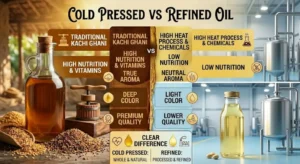
Cold pressing keeps oil below roughly 50°C during extraction, so heat-sensitive vitamin E, polyphenols, and other antioxidants stay intact instead of breaking down the way they do in refined oils. That single temperature difference is the reason a bottle of cold pressed oil looks, smells, and behaves so differently from the refined version sitting next to it on the shelf.
What Is Cold Pressing?
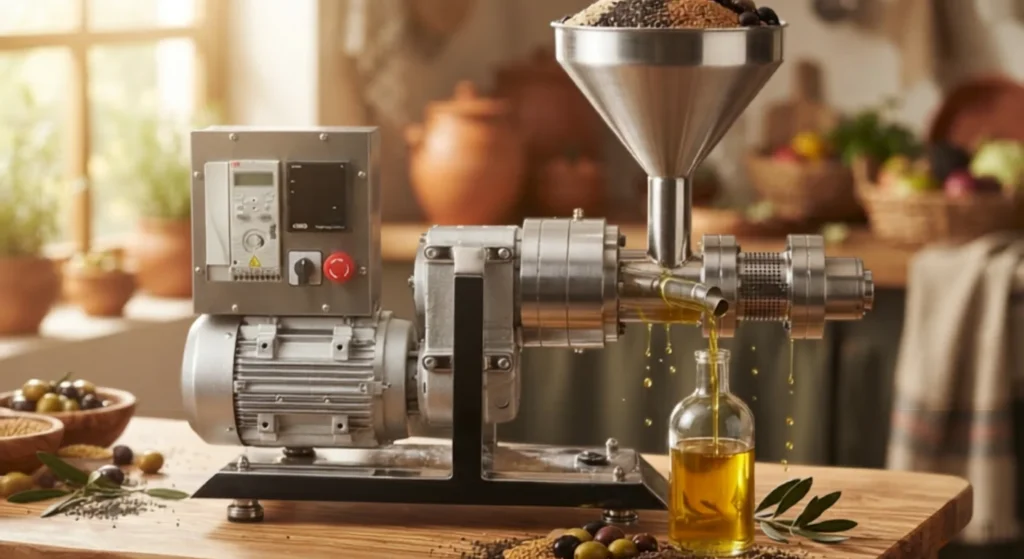
Cold pressing is a mechanical extraction method that squeezes oil out of seeds, nuts, or fruits using hydraulic or expeller pressure, without added heat or chemical solvents. According to peer-reviewed research on cold-pressed specialty oils published via the U.S. National Institutes of Health, cold-pressed oils must be produced only through mechanical procedures and cannot involve any heat treatment to qualify under the Codex Alimentarius standard.
The process is straightforward:
- Cleaning and drying the raw seeds or nuts
- Mechanical pressing in a hydraulic or expeller press, kept below ~50°C (122°F)
- Settling or light filtration to remove solid residue, without further chemical treatment
Because there’s no bleaching, deodorizing, or solvent step, the oil retains its natural color, aroma, and biochemistry almost exactly as it existed in the raw seed.
Why Does Heat Destroy Vitamins and Antioxidants in Oil?
Heat destroys vitamins and antioxidants because it speeds up oxidation and breaks down heat-sensitive molecular structures like tocopherols (vitamin E) and polyphenols. These compounds are chemically fragile; many are unsaturated or contain reactive hydroxyl groups that degrade rapidly once exposed to high temperatures.
Refined oil production typically involves deodorization, a steam-distillation step run at 220–270°C to strip odor and taste. A peer-reviewed study on cold-pressed vegetable oil formulation found that industrial refining reduces total polyphenol content in oils by roughly 52% to 67%, largely without significantly altering the fatty acid profile itself. A related NIH-indexed study on sunflower oil refining found that tocopherol levels measured in the hundreds of mg/kg in crude oil dropped sharply after each refining stage, especially during bleaching and deodorization.
What Happens During Refining That Cold Pressing Avoids?
Refining strips nutrients through a multi-stage industrial process that cold pressing simply never touches:
- Solvent extraction: Hexane is used to pull oil from seed pulp at high yield
- Degumming: Removes phospholipids along with some naturally occurring nutrients
- Neutralization: Strips free fatty acids using sodium hydroxide
- Bleaching: Activated clay removes color pigments, including carotenoids
- Deodorization: High-heat steam distillation removes aroma compounds along with much of the remaining vitamin E and polyphenols
Cold pressing skips every one of these steps, which is precisely why the nutrient profile stays close to what’s naturally present in the raw seed.
Which Vitamins and Antioxidants Survive Cold Pressing?
Cold-pressed oils retain vitamin E (tocopherols), polyphenols, phytosterols, carotenoids, and chlorophyll; compounds that are largely destroyed during industrial refining. Each plays a distinct protective role:
- Vitamin E (tocopherols): A fat-soluble antioxidant that protects cells from oxidative damage and also helps slow oxidation within the oil itself
- Polyphenols: Plant compounds linked to anti-inflammatory and antioxidant activity, especially concentrated in oils like extra virgin olive oil
- Phytosterols: Plant sterols associated with supporting healthy cholesterol balance
- Carotenoids and chlorophyll: Responsible for the natural color of unrefined oils, and destroyed almost entirely during bleaching
Specific examples make this concrete. Cold pressed mustard oil retains natural antioxidants along with omega-3 and omega-6 fatty acids because it’s extracted mechanically without chemical processing. Extra virgin olive oil is prized for its polyphenol content, sesame oil contains the antioxidant sesamol, and flaxseed oil carries lignans alongside its omega-3s. A PMC study on the antioxidant activity of cold-pressed oils similarly confirms their higher concentration of bioactive compounds compared with refined equivalents.
How Does Oxygen and Light Exposure Affect Nutrient Retention After Pressing?
Oxygen and light exposure after pressing can undo much of what cold pressing preserves, since tocopherols and polyphenols continue to degrade once the oil is bottled. A PMC study on cold-pressed hempseed oil storage found that alpha-tocopherol levels dropped meaningfully over just 12 weeks, with the rate of loss depending heavily on filtration and light exposure.
This is why the extraction method is only half the story. What happens after pressing matters just as much:
- Store oil in dark glass bottles, away from direct sunlight
- Keep the cap tightly sealed to limit oxygen contact
- Use within the recommended shelf life rather than stockpiling large quantities
- Avoid storing near heat sources like stovetops
Does Cold-Pressed Always Mean Healthier?
Not automatically; cold-pressed oil only delivers its nutritional advantage if it’s genuinely unrefined and used the way it’s meant to be used. Two caveats matter here.
Labeling isn’t always accurate: Some products marketed as “cold-pressed” are blended with refined oil or only partially meet the mechanical-extraction standard. Genuine cold-pressed oil typically shows a natural color, a distinct seed aroma, and slight sediment at the bottom of the bottle.
Smoke point limits high-heat use: Cold-pressed oils generally have lower smoke points than refined oils, since the compounds that make them nutritious also make them less heat-stable. Deep-frying or repeated high-heat cooking with a delicate cold-pressed oil can cause it to break down and produce compounds you don’t want in your food. For daily low-to-medium heat cooking, sautéing, or finishing dishes, cold-pressed oils like olive oil work well; for high-heat frying, a more heat-stable oil is the better fit.
If you’re managing a specific health condition or making a significant dietary change, it’s worth checking with a doctor or registered dietitian, since individual fat and calorie needs vary.
How Should You Use and Store Cold-Pressed Oils to Retain Nutrients?
To retain the nutrients cold pressing preserves, use these oils at low-to-medium heat, store them away from light and heat, and buy in quantities you’ll use within a few months.
- Reserve cold-pressed oils for sautéing, dressings, marinades, or finishing rather than deep frying
- Buy smaller bottles more often instead of one large bottle that sits open for months
- Keep the bottle sealed and refrigerated if you live somewhere hot, to slow oxidation further
- Don’t mix cold-pressed oil with refined oil in the same bottle; it dilutes the nutrient advantage
- Check the label for a harvest or pressing date, not just an expiry date
Frequently Asked Questions